
Part thickness is a fundamental geometric characteristic that exerts a dominant influence on cooling time and the propensity for warpage in injection molded components. Thicker sections take significantly longer to cool than thinner ones because heat must conduct from the center of the part to its cooled outer surfaces. This relationship is not linear; cooling time increases roughly with the square of the thickness. Therefore, doubling the wall thickness can nearly quadruple the time needed for the center of the part to solidify, creating a major bottleneck in the production cycle.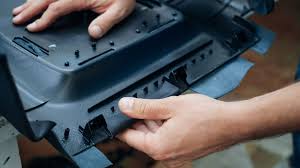
This disparity in cooling rates within a single part leads directly to the issue of warpage. As the outer layers of a thick section cool and contract first, they pull on the still-hot, more viscous inner core. When the core finally cools and attempts to shrink, it is constrained by the already-solidified outer shell. This mismatch in shrinkage creates internal stresses. Once the part is ejected and freed from the mold's constraint, these locked-in stresses relax, causing the part to bend or twist into a warped shape, rendering it unusable or requiring costly secondary correction processes.
Uniform wall thickness is the primary design rule to mitigate these problems. By keeping walls as consistent as possible, cooling rates are more uniform, minimizing both cooling time and internal stress buildup. When varying thickness is unavoidable, design techniques like using fillets to gradually transition between sections or incorporating flow leaders (thin ribs) can help equalize cooling paths. These strategies aim to make the cooling behavior of different sections more similar, reducing the overall cycle time and warpage risk.
Material selection also plays a role. Semi-crystalline materials like polyethylene or nylon tend to shrink more and more abruptly upon cooling than amorphous materials like polystyrene or ABS. This makes them more prone to warpage in thick sections. Understanding the specific thermal and shrinkage properties of the chosen material allows designers and processors to anticipate and counteract these effects through mold design (e.g., targeted cooling) and process optimization (e.g., longer, more controlled cooling phases), although this often comes at the cost of increased cycle time.

