
Modern injection molding industries increasingly require higher precision, shorter development cycles, and lower production risks. For silicone molds and plastic injection molds, even small design errors may lead to flashing, short shots, warpage, weld lines, air entrapment, or dimensional instability.
As product structures become more complex, mold flow analysis has become an essential engineering tool for optimizing mold design before actual production begins.
Mold flow analysis is a computer-based engineering simulation process used to evaluate how molten materials flow inside mold cavities during injection molding.
The technology allows engineers to predict potential manufacturing issues before molds are physically produced.
Instead of discovering problems after mold manufacturing is completed, engineers can optimize the design during the digital development stage.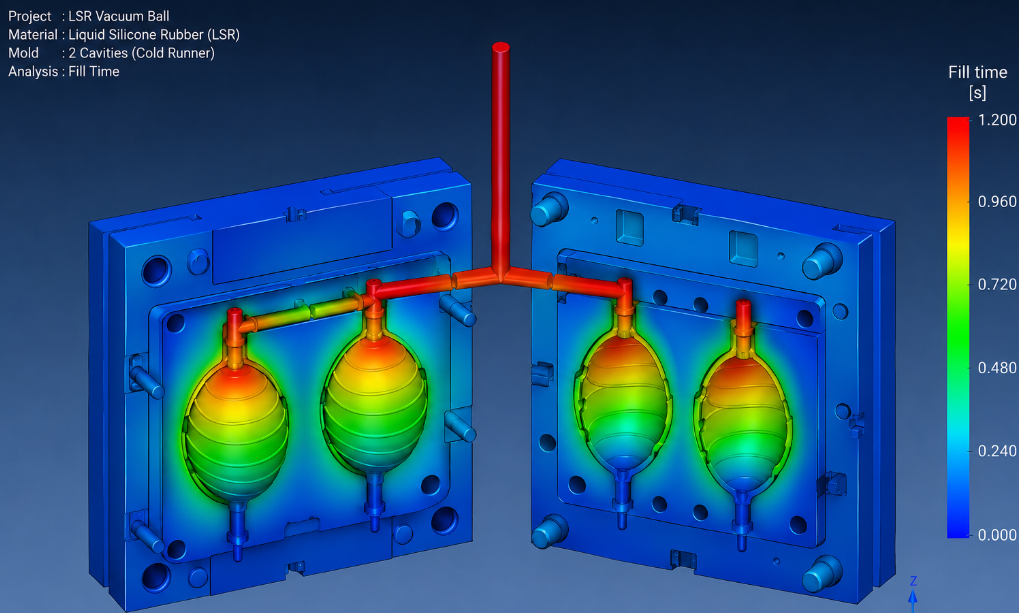
Liquid Silicone Rubber materials behave differently from traditional thermoplastics because LSR has extremely low viscosity and high flow sensitivity.
Poor mold design may lead to flashing defects, unstable filling behavior, or uneven curing.
As a result, mold flow analysis plays a critical role in LSR mold engineering.
Balanced filling is one of the most important factors in multi-cavity mold performance.
If material flow becomes uneven between cavities, manufacturers may experience dimensional inconsistency, unstable curing, or uneven flashing.
Flow simulation helps engineers optimize runner systems, gate locations, and cavity layouts before production begins.
Air entrapment is a common problem in silicone molding because trapped gas may create burn marks, incomplete filling, or unstable surface quality.
Mold flow analysis can identify potential air trap areas during the early design stage, allowing engineers to optimize venting structures before mold manufacturing begins.
Traditional mold development often required repeated mold trials and manual adjustments after production began.
Today, simulation technologies allow engineers to identify risks digitally before steel cutting begins.
This helps manufacturers shorten development cycles, improve product reliability, and accelerate time-to-market.
Modern mold engineering increasingly integrates simulation technologies with intelligent manufacturing systems.
Engineers can now combine mold flow analysis with 3D mold design, CNC machining, AI-assisted process optimization, production monitoring systems, and automated quality inspection.
This creates a more data-driven manufacturing process capable of improving long-term production stability.
Q1:Why is mold flow analysis important before production?
A:Mold flow analysis helps identify manufacturing risks such as air traps, warpage, flashing, and filling imbalance before mold production begins.
Q2:Is mold flow analysis useful for LSR molding?
A:Yes. Because LSR materials are highly sensitive to flow conditions and curing behavior, simulation is especially important for silicone mold design.
Q3:How does simulation reduce manufacturing cost?
A:Simulation reduces mold modification frequency, shortens development time, and improves production reliability before mass production starts.
Mold flow analysis has become an essential technology for modern injection mold engineering because it allows manufacturers to reduce production risks before actual manufacturing begins.

